Monday, September 19, 2016

Grocery Stores Were Family Businesses

Grand Opening at Harold Saltz "super market"
on Old Hendersonville Highway in Brevard, 1950.
Grocery stores of the early to mid-1900s were generally small family run businesses, although there were some large chains such as A&P and Piggly Wiggly.  These stores typically carried non-perishable food packaged in cans, bottles and boxes, fresh produce, dairy products and meat.  Miscellaneous things like pencils and tablets, cigarettes, toiletries, and small hardware items were commonly available as well.

A town the size of Brevard had several grocery stores.  The 1947 Citizen’s Telephone directory lists Broadway Grocery, Cash & Carry Market, French Broad Grocery, Home Grocery, Mitchem’s Grocery, Mull’s Market & Grocery, and Scott’s Grocery all in the downtown area.  There was also an A&P downtown and at least four other grocery stores were on the outskirts of Brevard.

Ray Burgin inside his store.
Burgin’s Grocery Store on old Highway 64 was 20 years old and the former home of three previous stores when Ray Burgin bought it in 1945.   Burgin moved the store back from the road, enclosed a porch and added on to the building.  He sold groceries, fresh produce, dairy products, packaged meats, plus some odds and ends.  In 1962 the store began operating 7-days a week, with late evening hours.  Burgin’s was the place to get whatever had been forgotten on the big weekly shopping trip.  Burgin’s Grocery closed in in the mid-1970s following Ray Burgin’s death in 1973.

In 1923 M.O. and Myra McCall opened a grocery store along Highway 64 in Quebec on property that had originally belong to Myra’s grandfather, John Whitmire.  The store sold canned goods, candy and a few other general items.  Everyone in the surrounding rural area raised farm animals and had large gardens so meat, dairy, and produce were not carried.  M.O. McCall passed away in 1963 and the store closed a year later.  The building was torn down in 1988.

Inside Cascade Grocery in the Little River community, 1991.
Dozens of other family owned and operated grocery stores were scattered throughout the communities of Transylvania County where nearby residents could purchase food and small items and gather to visit with neighbors.  If you have photographs of some of these stores that you would like to preserve for future generations please contact the Local History Room staff at the library.


Photographs and information for this column are provided by the Rowell Bosse North Carolina Room, Transylvania County Library.  Visit the NC Room during regular library hours (Monday-Friday) to learn more about our history and see additional photographs.  For more information, comments or suggestions contact Marcy at marcy.thompson@transylvaniacounty.org or 828-884-3151 X242.


Monday, September 12, 2016

Franklin Hotel Offered Several Amenities

This photograph shows the size the Franklin Hotel from the front.
Large wings of both sides of the back created a V shaped building.
The Franklin Hotel opened in Brevard in July 1900.  J. Frances Hayes and his business partners had purchased the Hendersonville-Brevard Railway Telegraph and Telephone Company, renamed it Transylvania Railroad Company and planned to expand the line beyond Brevard.  They agreed to construct a luxury hotel in Brevard to garner support for a $25,000 bond to aid in financing the rail line extension.

The 80-acre property included tennis courts and a small lake in a park-like setting.  The hotel, which could accommodate 150-200 guests, had a large veranda where cool evenings could be enjoyed.  There was regularly an orchestra and dancing.

Franklin Hotel Dining Room.
An early tourism brochure described it as, “thoroughly modern and luxurious in appointments and furnishings, and ranks as one of the best resort hotels in America.  It occupies the highest point in Brevard, and is surrounded by a park of eighty acres, overlooking in the French Broad river and valley.  Every room is an outside room with a pleasant outlook and commanding view of mountain and valley, and many are arranged en suite, with private bath, for families.”

Carl Schenck states in his book, Birth of Forestry in America, “rooms with real baths were obtainable, and my frequent overnight stays in Brevard ceased to be disturbed by fleas, bedbugs, and rats.”

Despite the wonderful accolades the hotel was sold four times by 1909.  In January 1909 T.W. Whitmire and other investors purchased the property.   Lots from the hotel’s 80 acres were to be sold for $500 each.  Conditions for lot purchase included building a residence costing at least $2000 on the property within 2 years.

Over the next 40 years the hotel changed hands numerous times.  In 1919 J.C. and H.W. Wooten purchased the hotel with plans to update and improve it.  In 1925 additional improvements were made, including a two-story addition to the east wing and a screened porch on the back.  In 1936 it was announced that steam heat would be added to allow for winter guests as well.

By the late 1940’s the old hotel was showing its age.  For several years Miss Annie Shipman was the manager.  Transylvania Times articles show that it was open for summer visitors at least through the 1949 season.

On September 17, 1950 the congregation of the Brevard-Davidson River Presbyterian Church voted to purchase the hotel and 7 acres.  The hotel dining room became the sanctuary, bedrooms were converted into Sunday School classrooms, and a new Manse was built behind the old hotel.  In March 1956 the old hotel was torn down to make way for construction of the current church. 


Photographs and information for this column are provided by the Rowell Bosse North Carolina Room, Transylvania County Library.  Visit the NC Room during regular library hours (Monday-Friday) to learn more about our history and see additional photographs.  For more information, comments or suggestions contact Marcy at marcy.thompson@transylvaniacounty.org or 828-884-3151 X242.

Monday, September 5, 2016

Estatoe Path Was First Major Road in County

The Estatoe Path was likely the earliest road through what is today Transylvania County.  Long before Europeans ventured into the area a path was being carved through the valleys between the higher mountains to the north and the lowlands to the south.  The path was not one defined roadway, but rather an intertwining network of trails first worn into the earth by migrating animals.

Buffalo once roamed in this area.
Buffalo, elk, and deer were efficient travelers, taking the easiest route to their grazing grounds and water sources.  Wolves and mountain lions also travelled these paths as they followed the herds and hunted.

The early native people who lived and roamed throughout the area used these same paths.  Later the Cherokee would use them as they moved between their valley towns in present day northwestern South Carolina and northeastern Georgia up the French Broad River to their over-the-hill towns in the mountains of what is now Western North Carolina.  The Cherokee also used the smaller trails branching off the main path as they hunted game, harvested berries and nuts, and gathered hardwood, flint, and copper for their tools. 

As explorers, trappers, and traders came into the region they too used these paths, continuing to widen the principle trails.  Trappers transported furs from the mountains to port in Charleston and goods from Charleston back into the mountains for trading.

North Carolina historical highway markers in Transylvania County
commemorate the Estatoe Path.
When settlers arrived in the late 1700s the local militia was ordered to build a wagon road following near the Estatoe Path from the Swannanoa River to Mills River to Davidson River.
A few years later Buncombe County Court ordered the laying out of a road from the (Estatoe) Ford of Ben Davidson’s River to the middle fork of the French Broad River.

In September 1956 North Carolina historical highway markers were placed on US 178 at the French Broad River Bridge in Rosman and on US 64-276 at the Davidson River Bridge northeast of Brevard recognizing the Estatoe Path.  The markers read, “Trade route between mountain settlements of the Cherokee and their town, Estatoe, in what is now South Carolina passed nearby.”

Photographs and information for this column are provided by the Rowell Bosse North Carolina Room, Transylvania County Library.  Visit the NC Room during regular library hours (Monday-Friday) to learn more about our history and see additional photographs.  For more information, comments or suggestions contact Marcy at marcy.thompson@transylvaniacounty.org or 828-884-3151 X242.

Monday, August 22, 2016

Devil's Courthouse is a Popular Destination

Devil’s Courthouse is a popular sightseeing stop along the Blue Ridge Parkway but it is much more than just a nice view. 

The highest point is 5720 feet above sea level and offers a 360 degree view.  The large rock outcropping with steep cliffs flows into a mix of bare rock and shrubby areas and then spreads into spruce-fir and northern hardwood forests, all home to rare plants and animals.

In An Inventory of the Natural Areas of Transylvania County, North Carolina Edward Schwartzman states that there are “eleven rare vascular plant species and nine species of rare bryophytes and lichens” at Devil’s Courthouse.  It is the only place in Transylvania County where Appalachian fir-clubmoss, sticky bog-asphodel and deerhair bulrush are found.

Schwartzman also identifies the Carolina northern flying squirrel, brown creepers, hermit thrush, and Southern Appalachian black-capped chickadees as rare animals living there.

The site lies in the heart of the early Cherokee tribal territory and has a significant role in their ancient story of “Tsul’ Kalu’, or Judaculla, The Slant-Eyed Giant.”   

Devil's Courthouse at Milepost 422 on the Blue Ridge Parkway.
Judaculla is a mysterious superhuman giant who lives and farms high in the mountains.  He is the owner of all game and it is here that he sits in judgement of how animals are treated.  In his book, Seven Cherokee Myths, Transylvania native Keith Parker explains, “Judaculla would consider how persons dealt with game.  Did they take only what they needed?  Did they do the right ritual before taking down an animal, with apology and thanksgiving?”  Punishment would be given to those who violated the rules.

In the late 1800s travel adventure books where popular reading.  It is from one such book that the name Devil’s Courthouse and the story of the devil holding court in a cave within the rock cliff derives.  With the completion of that section of the Blue Ridge Parkway after WWII Devil’s Courthouse became much more accessible.  Early publicity passed this sensational but erroneous tale of Devil’s Courthouse on to visitors.

Parker’s book provides readers a look at the Southern Appalachians from the perspective of Cherokee traditions and beliefs.  Schwartzman’s book details the land, flora, and fauna of Transylvania County.  Both are available at the Transylvania County Library for anyone interested in learning more.
                               

Photographs and information for this column are provided by the Rowell Bosse North Carolina Room, Transylvania County Library.  Visit the NC Room during regular library hours (Monday-Friday) to learn more about our history and see additional photographs.  For more information, comments or suggestions contact Marcy at marcy.thompson@transylvaniacounty.org or 828-884-3151 X242.

Monday, August 15, 2016

Cradle of Forestry Preserves History

The Cradle of Forestry in America was officially dedicated in October 1964.  The goal was to show the role of forestry in the Appalachian Mountains and throughout the U.S., both today and in the past.  For 50 years the Cradle of Forestry’s interpretive exhibits have allowed visitors to experience and learn about our forests in the Forest Discovery Center Exhibit Hall and along the Biltmore Campus Trail and Forest Festival Trail.

It all began when George Vanderbilt started purchasing land southwest of Asheville in the 1890s.  Noted landscape architect Fredrick Law Olmsted developed a plan that included the house surrounded by a park-like setting with formal and informal gardens, farms near the French Broad and Swannanoa Rivers, and commercial forestry covering the mountains.  

Dr. Carl Schenck at the Biltmore Forest School marker
erected in his honor in 1950.
In 1892 Vanderbilt hired Gifford Pinchot to manage his vast property.  At the time planned forestry management was new to America.  Pinchot was American but had studied forestry in France.  The Pinchot family would later endow the Yale School of Forestry and Gifford would become the first Chief of the U.S. Forest Service.

In 1895 Carl Schenck replaced Pinchot and changed the direction of managing Vanderbilt’s forestland.  He worked to restore the forest that had been heavily logged.  Schenck established the first school of forestry in America which operated from 1898 until 1909.  The school combined traditional classroom learning and hands-on experience in the heart of the forest.

In 1914 Edith Vanderbilt sold over 86,000 acres to the U.S. Forest Service and in 1916 the Pisgah National Forest was created.  Fifty years later the Cradle of Forest would recreate the experience of forest education begun at Biltmore Forest School by Carl Schenck in George Vanderbilt’s forest.

Jesse McCall family outside of their home, one of the ranger lodges.
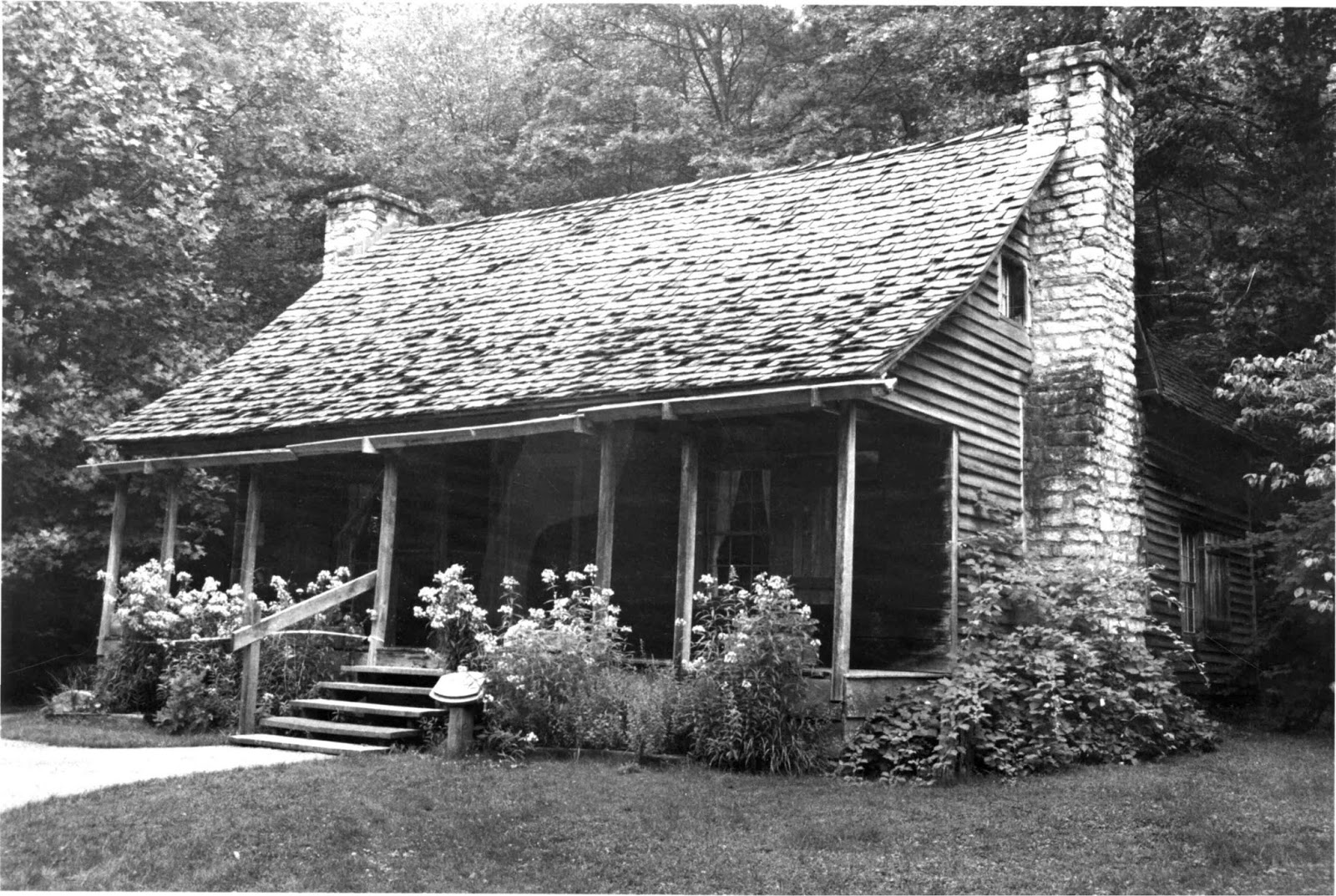
Original structures along the Biltmore Campus Trail include a lodge and the Hiram King House.  The lodge is a frame structure with heavy timber beams and has a high peaked roof in the Black Forest architecture style.  Originally there were 12 lodges for Vanderbilt’s Rangers who patrolled the forest for fire, poachers and timber thieves.  This lodge was moved to the current location.  The Hiram King House is a typical 1880s wooden frame house.  It was later used to lodge forestry students.  The trail also includes a reconstructed one-room schoolhouse, general store, blacksmith shop, and cabins.

Hiram King House at the Cradle of Forestry, photo taken in 1991.
Biltmore’s Landscape and Forest Historian Bill Alexander will discuss “Vanderbilt’s Forest” during the August 16 Bag Lunch at the Transylvania County Library.  On September 8, “America’s First Forest:  Carl Schenck and the Asheville Experiment”, a documentary film produced for the Forest History Society by Bonesteel Films will be presented at the Library.


Photographs and information for this column are provided by the Rowell Bosse North Carolina Room, Transylvania County Library.  Visit the NC Room during regular library hours (Monday-Friday) to learn more about our history and see additional photographs.  For more information, comments or suggestions contact Marcy at marcy.thompson@transylvaniacounty.org or 828-884-3151 X242.